
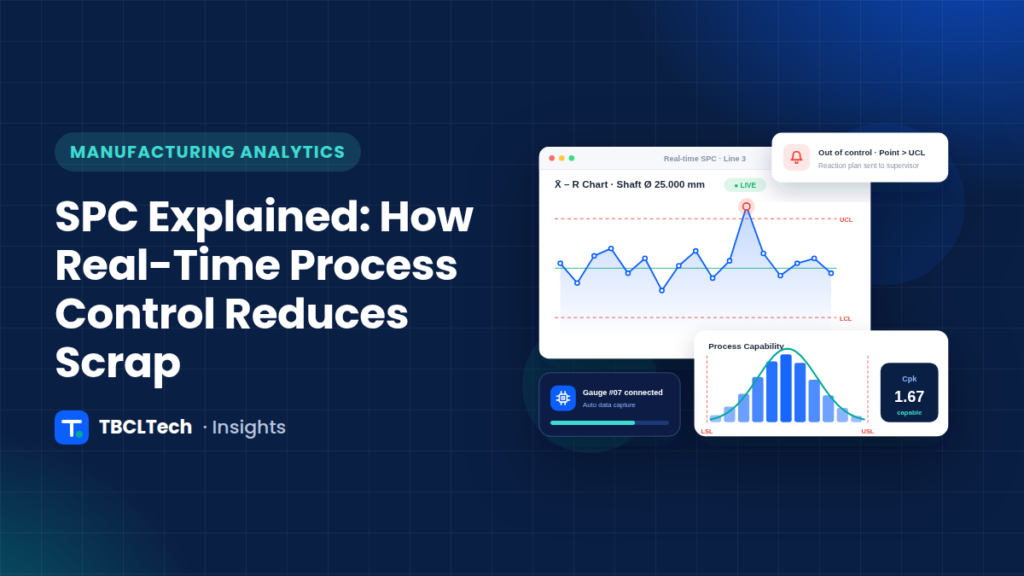
Every process varies. The question is whether that variation is normal, or whether something has changed that needs action. Statistical Process Control (SPC) answers that question objectively, and when it runs in real time on the shop floor, it prevents defects instead of just detecting them.
Common-cause vs special-cause variation
Walter Shewhart, the father of SPC, distinguished between two kinds of variation. Common-cause variation is the natural noise of a stable process. Special-cause variation comes from something specific: a worn tool, a new material lot, a changed setting. Reacting to common-cause variation (over-adjusting) makes things worse; missing special-cause variation lets defects through. Control charts separate the two.
The essential SPC toolkit
- Control charts: X-bar/R and X-bar/S for subgrouped variables data, Individuals/Moving Range for single readings, and p, np, c and u charts for attribute data.
- Run rules: Western Electric and Nelson rules detect trends, shifts and patterns before a point falls outside control limits.
- Capability indices: Cp, Cpk, Pp and Ppk show whether a stable process can meet specification.
- Measurement System Analysis: Gage R&R studies confirm that your measurement system can be trusted.
Why real-time matters
Paper-based SPC or end-of-shift spreadsheets tell you what went wrong hours ago. Real-time SPC software collects data directly from gauges, CMMs and machines, plots it instantly and alerts operators the moment a rule is violated. The reaction happens while the part is still on the machine, which is where the savings in scrap, rework and customer complaints come from.
Making SPC stick
- Start from risk. Use your PFMEA and control plan to choose which characteristics to chart.
- Automate data collection wherever possible to remove transcription errors.
- Define reaction plans so operators know exactly what to do when an alarm fires.
- Close the loop: link significant events to nonconformance and CAPA in your QMS.
- Review capability regularly and focus improvement where Cpk is weakest.
SPC and customer requirements
In automotive, IATF 16949 and the AIAG core tools expect statistical evidence of process control and capability as part of PPAP. Medical device and aerospace customers increasingly expect the same. A modern SPC platform such as DataLyzer produces this evidence automatically, together with linked FMEA and control plans.
TBCLTech implements real-time SPC, OEE and FMEA solutions and integrates them with enterprise quality systems. Book a consultation to see how SPC could work on your lines.