
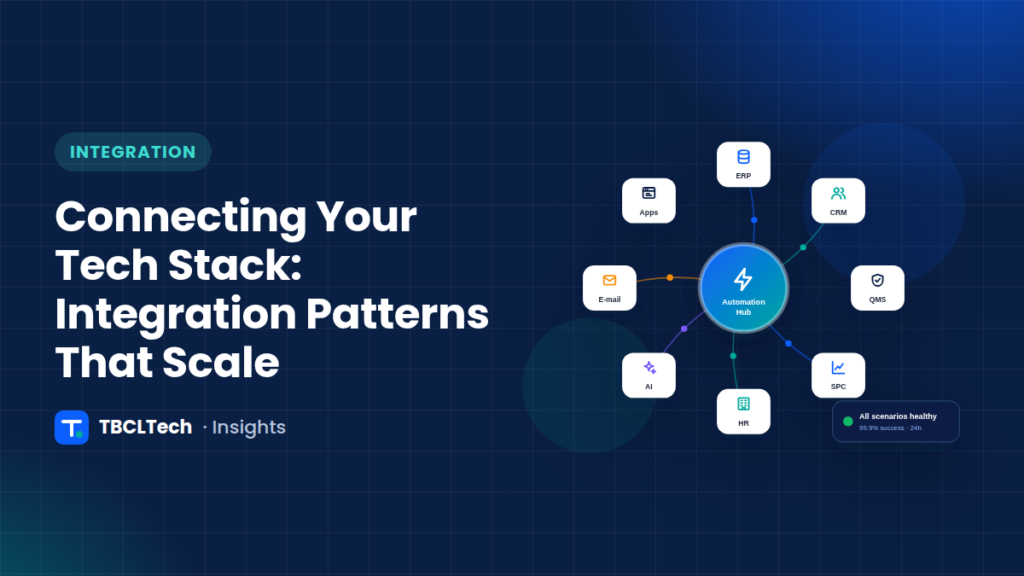
Modern businesses run on dozens of applications: ERP, CRM, QMS, e-commerce, HR, finance and collaboration tools. Visual automation platforms such as Make (formerly Integromat) make it possible to connect them in days instead of months. But moving from a quick automation to production-grade integration requires the right patterns.
Pattern 1: Event-driven over scheduled
Where the source system supports it, trigger scenarios from webhooks rather than polling on a schedule. Data moves in near real time, and you use fewer operations.
Pattern 2: Design for idempotency
Integrations will occasionally retry. Make sure processing the same message twice does not create duplicates, for example by using a unique external ID and “search, then create or update” logic.
Pattern 3: Handle errors deliberately
Use error handlers to retry transient failures, route bad data to a review queue and alert the right team. Silent failures are the most expensive kind.
Pattern 4: Keep a single source of truth
Decide which system owns each data object (customer, item, supplier, quality event) and synchronise in one direction wherever possible. Bi-directional sync needs clear conflict rules.
Pattern 5: Separate environments and document
Build and test in a development environment, promote to production deliberately, and document each scenario’s purpose, owner, systems and failure behaviour. This turns automations into supportable assets rather than personal projects.
Adding AI, responsibly
AI steps can classify incoming e-mails, extract data from documents or summarise records inside automated workflows. Start with human-in-the-loop review, measure accuracy, and expand as confidence grows.
Example: closing the quality loop
A practical example connects an SPC system, an enterprise QMS and ERP. When a critical out-of-control event occurs, a nonconformance is created automatically in the QMS, the affected lot is placed on hold in ERP and the quality engineer is notified, all within seconds and with a full audit trail.
TBCLTech designs and supports production-grade integrations on Make. Discuss your integration challenge with our architects.