
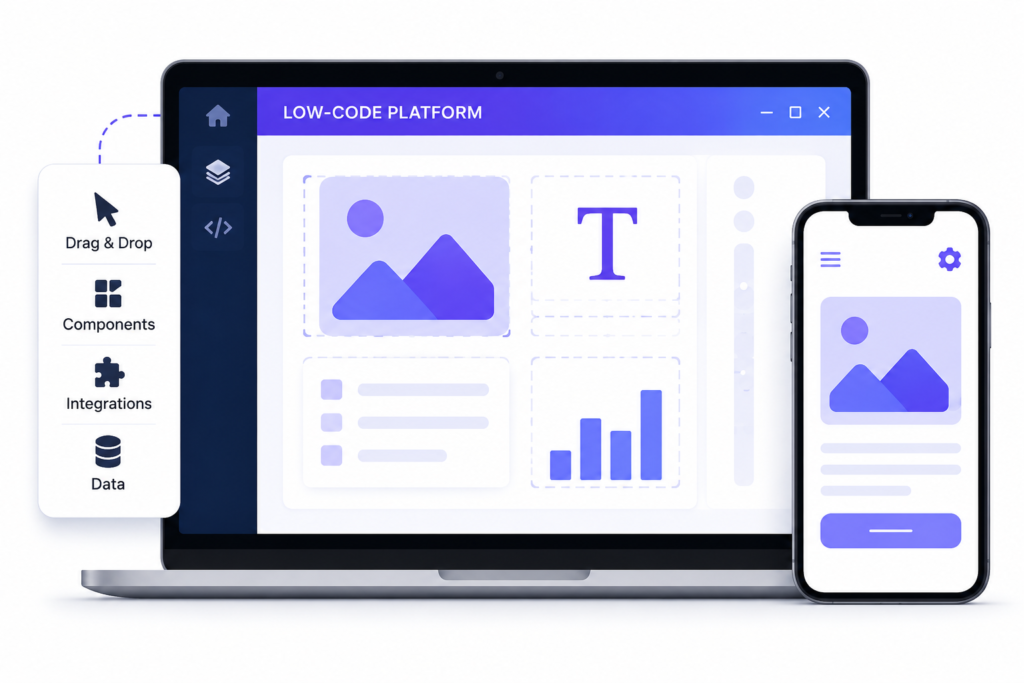
What is Low-Code and Why Enterprise Leaders are paying attention
In every industry, business leaders face the same challenge: the need to innovate faster than ever before. Whether it is launching a customer portal, automating internal workflows, modernizing legacy systems, or improving employee experiences, organizations often struggle with lengthy development cycles, limited IT resources, and growing technology backlogs.
As digital transformation accelerates, traditional software development approaches are increasingly unable to keep pace with business demands. This is where Low-Code development platforms are changing the game.
Low-Code is no longer viewed as an emerging technology trend. It has become a strategic enabler for enterprises looking to deliver applications faster, reduce costs, and empower business users to participate in innovation.
In this article, we explore what Low-Code is, why enterprises are embracing it, the benefits it delivers, real-world use cases, and what the future holds.
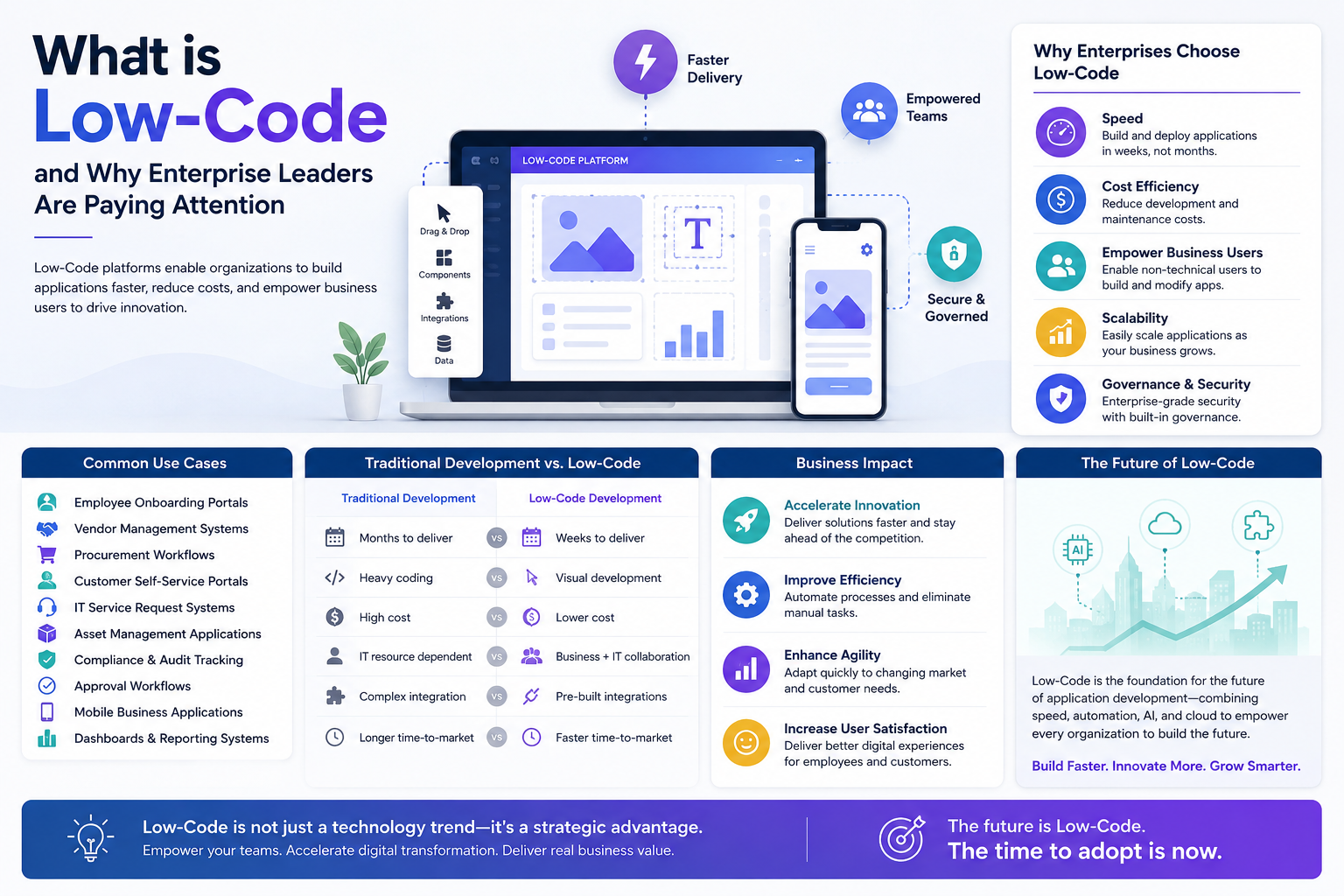
Understanding Low-Code
Low-Code is a software development approach that enables users to build applications through visual interfaces, drag-and-drop components, reusable templates, and pre-built integrations instead of writing thousands of lines of code.
While traditional application development relies heavily on manual coding, Low-Code platforms simplify and accelerate the development process by providing visual tools and automation capabilities.
This allows organizations to build everything from simple workflow applications to complex enterprise-grade systems significantly faster.
Examples of applications commonly built using Low-Code platforms include:
- Employee onboarding portals
- Vendor management systems
- Procurement workflows
- Customer self-service portals
- IT service request systems
- Asset management applications
- Compliance and audit tracking tools
- Approval workflows
- Mobile business applications
- Dashboards and reporting systems
Low-Code does not eliminate developers. Instead, it helps developers focus on high-value innovation while reducing the time spent on repetitive coding tasks.
Why Traditional Development is No Longer Enough
For years, organizations have relied on conventional software development methods. While these approaches provide flexibility, they often struggle to meet today’s business expectations.
A typical enterprise application project may require:
- Requirement gathering
- Design workshops
- Multiple development cycles
- Testing activities
- Integration efforts
- User acceptance testing
- Deployment phases
Even relatively simple applications can take months to develop and deploy.
Meanwhile, business users are demanding:
- Faster solutions
- Better customer experiences
- Digital workflows
- Mobile accessibility
- Real-time data visibility
The result is an ever-growing backlog of requests waiting for IT teams to address.
Many organizations continue to rely on spreadsheets, emails, and manual processes simply because application development takes too long.
Low-Code platforms address this gap by enabling rapid application delivery without compromising governance and security.
The Growing Demand for Low-Code
Digital transformation initiatives have become a top priority across industries.
Business leaders increasingly recognize that competitive advantage depends on the ability to quickly adapt to market changes, customer expectations, and operational demands.
Several factors are driving Low-Code adoption:
1. Developer Shortages
The demand for skilled software developers continues to exceed supply.
Organizations struggle to recruit and retain specialized development talent, creating delays in application delivery.
Low-Code platforms help teams accomplish more with existing resources.
2. Rising Application Demand
Every department now requires digital solutions.
HR teams need onboarding workflows.
Finance requires approval systems.
Procurement seeks automated vendor management.
Operations demand process automation.
Traditional development teams often cannot keep up with the volume of requests.
3. Need for Faster Time-to-Market
Businesses can no longer afford development cycles that extend for six to twelve months.
Products, services, and business processes must evolve continuously.
Low-Code dramatically reduces development timelines.
4. Increased Focus on Automation
Organizations are actively seeking opportunities to:
- Eliminate manual work
- Improve efficiency
- Reduce errors
- Increase productivity
Low-Code platforms provide a practical path toward enterprise automation.
Key Benefits of Low-Code for Enterprises
Faster Application Development
One of the most significant advantages of Low-Code is speed.
By using pre-built components and visual design environments, teams can build and deploy applications in weeks instead of months.
This faster delivery enables organizations to respond quickly to changing business needs.
Reduced Development Costs
Traditional development projects often require large teams and significant budgets.
Low-Code reduces development effort by:
- Reusing components
- Simplifying integration
- Automating testing
- Accelerating deployment
This can significantly lower the total cost of application development.
Improved Business and IT Collaboration
Historically, communication gaps between business teams and developers have resulted in delays and misunderstandings.
Low-Code platforms enable business stakeholders to actively participate in application design and workflow creation.
This collaboration improves outcomes while reducing rework.
Greater Agility
Market conditions evolve rapidly.
Organizations need the ability to:
- Modify workflows
- Update applications
- Launch new services
- Adapt to regulatory changes
Low-Code platforms make these adjustments much easier and faster.
Enhanced Productivity
Automation eliminates repetitive manual activities.
Employees spend less time managing email approvals, spreadsheets, and paperwork.
As a result, productivity improves across departments.
Better Governance and Standardization
Modern Low-Code platforms include features such as:
- Role-based access control
- Audit trails
- Security policies
- Compliance management
This ensures applications remain secure and aligned with organizational standards.
Enterprise Use Cases for Low-Code
Low-Code platforms deliver value across virtually every business function.
Human Resources
HR teams use Low-Code applications to manage:
- Recruitment approvals
- Employee onboarding
- Leave requests
- Performance reviews
- Employee self-service portals
Automation improves employee experiences while reducing administrative effort.
Procurement
Procurement departments can automate:
- Purchase requisitions
- Vendor onboarding
- Contract approvals
- Supplier evaluations
- Procurement tracking
These workflows improve visibility and accelerate purchasing processes.
Finance
Finance teams benefit from:
- Budget approval workflows
- Expense management systems
- Invoice processing automation
- Compliance tracking
The result is greater accuracy and operational efficiency.
Information Technology
IT departments leverage Low-Code for:
- Service request portals
- Incident management systems
- Asset tracking
- Change management workflows
This reduces manual effort and improves service delivery.
Customer Experience
Organizations can rapidly build:
- Customer portals
- Service request applications
- Self-service platforms
- Complaint management systems
These solutions improve customer satisfaction and engagement.
The Rise of Citizen Development
One of the most transformative aspects of Low-Code is the emergence of Citizen Developers.
Citizen Developers are business users who create applications using approved Low-Code platforms without extensive programming knowledge.
Examples include:
- HR managers designing onboarding workflows
- Finance teams building approval applications
- Operations leaders creating tracking systems
When governed correctly, citizen development helps organizations innovate at scale while reducing pressure on IT teams.
IT maintains oversight, while business units gain greater autonomy.
Low-Code and the Future of AI
Artificial Intelligence is increasingly being integrated into Low-Code platforms.
Future capabilities include:
- AI-generated workflows
- Intelligent process recommendations
- Automated application creation
- Natural language development
- Predictive analytics
- Smart automation
Imagine describing an application in plain language and having AI automatically create the workflow, user interface, and integrations.
This future is closer than many organizations realize.
The combination of AI and Low-Code will dramatically reduce development complexity and further accelerate digital transformation.
The Future Outlook
Enterprise software development is entering a new era.
Organizations are shifting their focus from writing code to solving business problems.
Low-Code platforms are becoming foundational tools for:
- Digital transformation
- Process automation
- Application modernization
- AI-driven innovation
- Citizen development
In the coming years, successful enterprises will not necessarily be those with the largest development teams.
They will be the organizations capable of rapidly translating ideas into business outcomes.
Speed, agility, and innovation will become the defining characteristics of market leaders.
Low-Code enables all three.
Conclusion
Low-Code has evolved from a niche development approach into a strategic enterprise capability.
It empowers organizations to deliver applications faster, automate processes, reduce costs, and respond rapidly to changing business needs.
For business leaders, the question is no longer whether Low-Code will become important.
The question is how quickly their organization can leverage it to gain a competitive advantage.
At TBCLTech, we believe Low-Code is not simply about building applications faster. It is about enabling organizations to innovate continuously, empower employees, and transform how business gets done.
Organizations that embrace Low-Code today will be better positioned to lead tomorrow’s digital economy.