Quality leaders are under pressure from every direction: tighter regulations, more demanding customers, global supply chains and the constant push to reduce cost. Yet in many organisations the quality system still runs on paper forms, shared drives and spreadsheets. A cloud quality management system (QMS) changes that by bringing every quality process onto one secure, connected platform.
What is a cloud QMS?
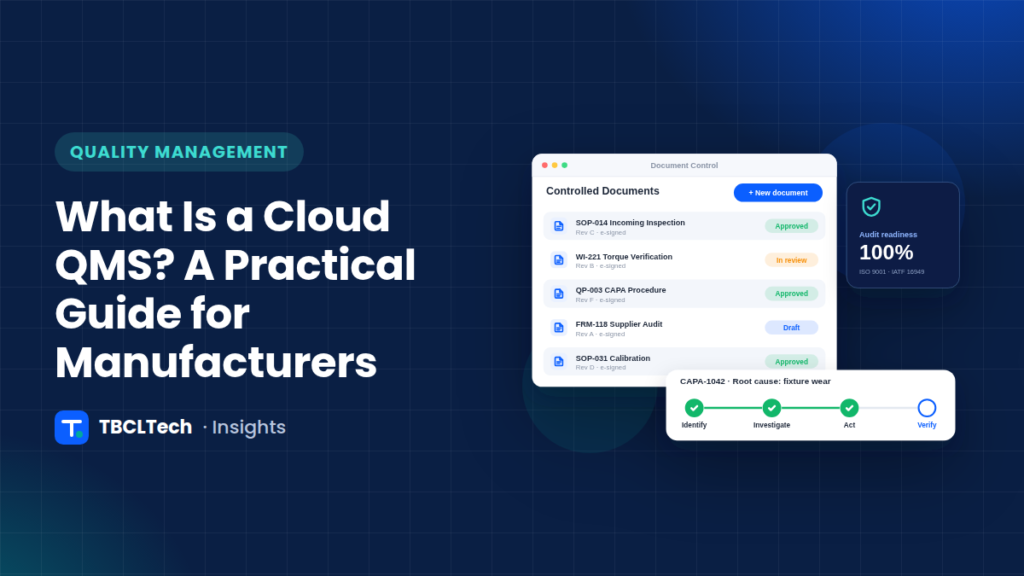
A cloud QMS is software, delivered as a service, that manages the processes defined in your quality management system: document control, training, nonconformance, CAPA, audits, supplier quality, complaints, change control and risk. Because it runs in the cloud, every site, supplier and remote team works from the same real-time data, and the vendor handles hosting, security patches and upgrades.
Core applications every QMS should include
- Document control: versioning, review and approval workflows, electronic signatures and controlled distribution.
- Training management: automatic training assignments when documents change, with competency records ready for audit.
- Nonconformance and CAPA: structured problem solving (5-Why, Fishbone, 8D) with effectiveness checks.
- Audit management: planning, checklists, findings and automatic follow-up actions.
- Supplier quality: approval, scorecards, SCARs and PPAP.
- Risk management: risk registers, FMEA and risk-based decision making embedded in processes.
Why manufacturers are moving to the cloud
The biggest benefit is connection. When a nonconformance is raised on the shop floor, the right people are notified immediately, investigations link to supplier records and training, and management sees trends in real time. Other advantages include faster deployment, lower IT overhead, automatic upgrades and easier multi-site standardisation.
Compliance considerations
For regulated industries, the platform must support the controls required by standards and regulations such as ISO 9001, IATF 16949, ISO 13485, AS9100 and FDA 21 CFR Part 11: audit trails, electronic signatures, role-based access and validated configurations. Ask vendors and implementation partners how they support computer system validation (CSV) or computer software assurance (CSA), and what documentation they provide.
How to evaluate a cloud QMS
- Configurability: can workflows, forms and rules be changed without code?
- Breadth: does the platform cover quality, EHS and compliance, so you can grow without adding new systems?
- Integration: are there proven connectors or APIs for your ERP, MES and PLM?
- Analytics: can you see cost of poor quality, CAPA cycle time and supplier performance at a glance?
- Implementation partner: does the partner understand your industry and standards, not just the software?
Getting started
The most successful programmes start with a focused core, typically document control, training, nonconformance, CAPA and audits, and expand in phases. Platforms such as Octave Reliance (formerly ETQ Reliance) offer more than 40 configurable applications on one cloud-native platform, which makes this phased approach straightforward.
TBCLTech helps organisations select, configure, integrate and validate enterprise QMS platforms. Talk to our quality specialists to plan your roadmap.